Paper Order Forms vs. Online Storefronts: What Actually Raises More
The Manila Envelope Problem
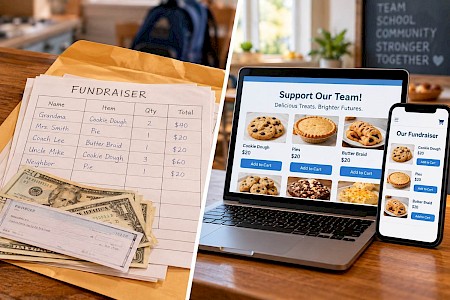
Every fundraiser chair knows the envelope. It comes home in a backpack, gets folded twice, and sits on a kitchen counter under a pizza menu for a week. When it finally comes back, there’s a twenty, three singles, a check with the wrong date, and an order form where someone’s grandmother wrote “2 apple” in the quantity box for cookie dough.
Paper order forms built school and team fundraising in this country. They still work in some situations. But the way people pay for things has changed a lot in the last ten years, and many groups still run their sales like it’s 2012.
So let’s get practical. Does going online actually raise more money, or is it just more convenient? We dug into the latest payment data from the Federal Reserve and Pew Research Center, plus online giving benchmarks from the nonprofit world. Here’s what the numbers say, where paper still earns its spot, and how to set up a sale that doesn’t leave money on the table.
How People Actually Pay Now
Here’s the headline. In a Pew Research Center survey from mid-2026, 42% of U.S. adults said they don’t use cash for any purchases in a typical week. In 2015, that number was 24%. Only 12% say they use cash for all or almost all of their purchases.
The Federal Reserve sees the same trend from a different angle. Its latest Diary of Consumer Payment Choice found that consumers made about 47 payments a month, and only six were in cash. That’s roughly 14%. Debit and credit cards handled about two-thirds of everything.
Now think about who you’re selling to. Your sellers’ parents, your coaches’ coworkers, the aunt who always buys two pies. Pew’s age breakdown is eye-opening:
|
Age group |
Make no cash purchases in a typical week |
Carry cash always or most of the time |
|---|---|---|
|
18 to 29 |
51% |
29% |
|
30 to 49 |
46% |
35% |
|
50 to 64 |
37% |
53% |
|
65 and older |
33% |
69% |
The 30 to 49 crowd is exactly the age of most school and sports parents. Nearly half of them don’t touch cash in a normal week, and only about a third reliably have it on them. When a parent hands a form to a coworker and the coworker says “I’ll bring cash tomorrow,” there’s a real chance tomorrow never comes.
And more buying is happening from a distance. The Fed reported that 23% of consumer purchases and person-to-person payments in 2024 were made remotely, a share that has grown every year since 2021. People are used to buying things from their phones, on their own schedule. A paper form asks them to do the opposite.
Where Paper Quietly Loses Money
Paper forms rarely fail dramatically. They leak. A few sales here, a few hours there. Here’s where it adds up.
The “I don’t have cash on me” sale. This is the big one. Somebody wants to buy. They mean it. They just can’t pay right now, and by next week they’ve forgotten. Let’s do some rough math. Say you have 40 sellers and each one loses just two sales this way. At a $20 item with 50% profit, that’s $800 your group never sees. And that’s a conservative guess.
The out-of-town family. Grandparents in Florida. An uncle in Ohio. They’d happily support your kid, but a paper form can’t reach them, and a frozen pastry can’t be mailed. So they either don’t buy or they send a check with a card, which is sweet but usually smaller than what they’d spend if they could actually pick something.
Math and handwriting. Somebody has to add up every form, match it to the cash in the envelope, and figure out why seller #23 is short $7. That’s usually a volunteer at a kitchen table at 10 p.m. Errors creep in, and fixing them eats even more time.
Cash handling risk. Envelopes of money traveling in backpacks is nobody’s favorite system. Lost cash is lost profit, and it’s awkward for everyone when it happens.
No visibility until the end. With paper, you have no idea how the sale is going until forms come back. You can’t nudge the kids who haven’t started because you don’t know who they are yet.
None of these is a disaster on its own. Together, they’re the difference between a good sale and a great one.
Where Paper Still Wins
We’d be doing you a disservice if we said paper is dead. It isn’t.
Cash is still part of daily life for many people. The Fed found cash was used for about one in seven payments, and rural residents averaged nine cash payments a month compared with six in cities and suburbs. Pew found that 69% of adults 65 and older carry cash always or most of the time. Many of your most loyal buyers, the grandparents and the church neighbors, fall right into that group.
Paper also works face-to-face in a way a link sometimes doesn’t. A kid standing on a neighbor’s porch holding a colorful brochure is hard to say no to. A text with a URL is easy to ignore.
And some people just don’t trust apps with their money. In a Pew survey on payment apps, two-thirds of adults 50 and older who had never used one said a major reason was that they didn’t trust these platforms with their money. You don’t want to lose those buyers either.
So the real answer isn’t “paper or online.” It’s both, set up so each one covers the other’s blind spots.
The Setup That Raises the Most: Paper Plus a Storefront
The groups that do best usually run a hybrid. Kids still carry a brochure door to door. But every seller also has their own online storefront link that parents can text, email, and post.
That way the neighbor with cash pays cash. The coworker with no cash taps a link and pays by card in 30 seconds. And Grandma in Arizona buys something that ships straight to her door.
Here’s how that works with MCM’s online fundraising platform:
- Credit card checkout. Buyers pay online, so there’s far less cash and paperwork to chase.
- A digital storefront for every seller. Share it on Facebook, Instagram, group texts, or email in a couple of taps.
- Automatic tallies. Orders and profit are totaled by individual seller and for the whole group, so no one has to add columns at midnight.
- Ship-to-home for out-of-state supporters. Our Simply Shipped Collection is included in every online fundraiser. Gifts, treats, and beverages ship anywhere in the U.S.
- Reminders built in. Add participant contact info and the system can send reminders and announcements, which helps pull in the sellers who haven’t started yet.
One tip from the nonprofit world: design for phones. M+R’s 2026 Benchmarks study found mobile devices made up 52% of nonprofit website traffic but only 28% of online revenue. Mobile visitors also gave smaller amounts on average, $88 compared with $168 on desktop. The lesson for your sale is simple. Keep the ask short, make the link easy to tap, and post a clear photo of the product. The easier the checkout feels on a phone, the more of those taps turn into orders.
Want to see it before you commit? You can try the demo storefront right from our homepage, with versions for our nationwide programs and our New England frozen favorites like Butter Braid® Pastry and Lyman Orchards® Pies.
The Bottom Line
Paper forms aren’t the enemy. They’re just not enough on their own anymore. When four in ten adults go a full week without using cash, a paper-only sale turns away willing buyers without anyone noticing.
Adding an online storefront fixes the biggest leaks. You reach buyers who don’t carry cash, family members who live out of state, and sellers who need a nudge. You also spend a lot less time counting money and matching envelopes.
If you’re planning a fall or holiday sale, now is a good time to set it up. Signing up takes less than five minutes, and our programs earn up to 50% profit. Questions first? Request info or call our team at 888-774-5889.
Frequently Asked Questions
Do Online Fundraisers Really Raise More than Paper Order Forms?
In most cases, a hybrid raises the most. Online checkout captures buyers who don’t carry cash and supporters who live far away, while paper still works well for older and cash-preferring buyers. Pew found 42% of U.S. adults make no cash purchases in a typical week, so a paper-only sale misses a lot of people.
Can We Still Accept Cash and Checks if We Go Online?
Yes. Most groups keep a paper form for in-person sales and use the online storefront for everyone else. Both sets of orders come together before delivery.
How do Out-of-State Family Members Buy?
They use the seller’s storefront link. With MCM, our Simply Shipped Collection is included in every online fundraiser, so relatives anywhere in the U.S. can order items that ship directly to them.
Is Online Payment Safe for Buyers?
Buyers pay by credit card through a secure checkout. Buyers never hand cash to a child, and the group never has to store envelopes of money.
Won’t Older Buyers Struggle with an Online Store?
Some might, and that’s fine. Keep the paper brochure for them. Pew found 69% of adults 65 and older carry cash most of the time, so a hybrid sale lets them buy the way they’re comfortable.
How Long Does It Take to Set Up an Online Fundraiser with MCM?
Signing up takes less than five minutes. From there, our team helps you pick a program, set your dates, and share your storefront.
How Much Profit Can Our Group Earn?
MCM programs earn up to 50% profit. All Poppin Popcorn fundraisers earn 50%, and our donation-based FundIt campaign returns 85% of collected donations to your organization.
Sources
- Pew Research Center, Fewer Americans use cash today than a decade ago, but many still carry it (August 2026)
- Federal Reserve Financial Services, 2026 Diary of Consumer Payment Choice (May 2026)
- Federal Reserve Financial Services, 2025 Findings from the Diary of Consumer Payment Choice (2025)
- M+R, Benchmarks 2026: Website Performance (2026)
- Pew Research Center, Payment app users say they make paying easier, but security a concern for some (September 2022)
- MCM Fundraising, FundIt Campaign Fundraiser